Live Dealer Tech Stack: Cameras, Streams, and Split-Second Decisions
15 Apr 2026
Live Dealer Tech Stack: Cameras, Streams, and Split-Second Decisions

The Backbone of Immersive Live Dealer Experiences
Live dealer games bring the buzz of a physical casino straight to players' screens, and none of it happens without a rock-solid tech stack working behind the scenes; cameras capture every shuffle and flip, streams beam it out with barely a blink of delay, while software crunches split-second decisions to keep the action flowing smoothly. Providers like Evolution Gaming and Pragmatic Play have pushed this tech forward over the years, turning what was once a clunky novelty into a multi-billion-dollar cornerstone of online gaming, with global market figures from Alcohol and Gaming Commission of Ontario reports showing live dealer segments growing by 25% annually through 2025. Experts who track these developments point out how the stack integrates hardware, encoding protocols, and AI-driven analytics, all tuned for latencies under 100 milliseconds— that's the sweet spot where players feel like they're right there at the table.
But here's the thing: this isn't just about slapping a webcam on a dealer; studios in places like Malta, Latvia, and the Philippines run 24/7 operations with redundant systems, because one glitchy feed can tank player trust overnight. Take one setup observers have studied at a major provider's facility, where over 200 tables stream simultaneously; data indicates uptime hits 99.99%, thanks to failover cameras and edge computing that reroutes signals before anyone notices a hiccup.
Cameras: Eyes on Every Angle and Action
High-end PTZ cameras—pan-tilt-zoom models from brands like Sony and Panasonic—form the front line, often deployed in arrays of four to eight per table, each one locked on specifics like the dealer's hands, the shoe, or player betting spots; resolutions push 4K or even 8K now, with frame rates at 60fps ensuring buttery-smooth motion even during rapid card deals. Researchers who've dissected these rigs note how infrared capabilities kick in for low-light scenarios, while anti-glare coatings and macro lenses zoom in on chip stacks down to the millimeter, preventing any blind spots that could spark disputes.
And it's not static; automated tracking software swivels these cameras based on game phase—zoomed out for the shuffle, tight on the flop for poker— all synced via Genlock to avoid drift between feeds. One case from a 2024 audit by the Nevada Gaming Control Board highlighted a blackjack setup with overhead fisheye lenses overlaying the entire layout, feeding data to reconstruction software that lets players switch virtual viewpoints mid-hand. What's interesting is how dual-streaming works here, with a high-res feed for visuals and a low-bandwidth metadata stream piping bet outcomes separately, slashing overall data needs by 40% according to industry benchmarks.
Yet challenges persist; dust or fingerprints can fog lenses, so robotic cleaners and nitrogen-purged housings keep things pristine, while calibration happens daily to maintain color fidelity across global time zones.
Streaming Tech: Low-Latency Magic Over the Wires
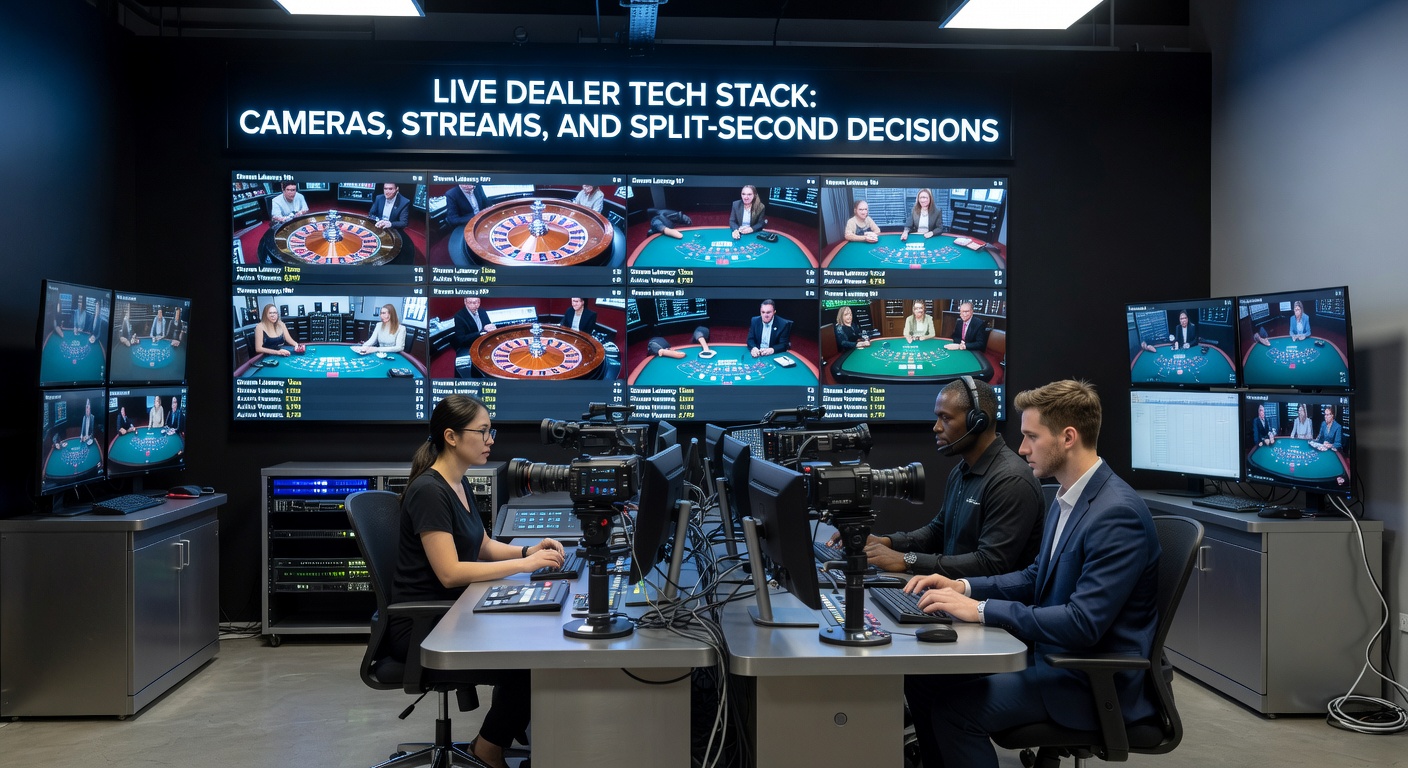
Once captured, video hits encoders running H.265 or AV1 codecs, compressing feeds without losing that crisp edge, then protocols like WebRTC or SRT hurl them across CDNs—content delivery networks—with sub-50ms glass-to-glass latency; that's from camera sensor to player device, a feat that adaptive bitrate streaming makes possible by tweaking quality on the fly based on connection speed. Data from provider whitepapers reveals how SRT, with its error correction packets, outperforms RTMP in packet-loss heavy regions like parts of Asia or rural North America, recovering 98% of dropped data in under 100ms.
Turns out, multi-bitrate ladders are key; a feed might offer 1080p at 8Mbps for fiber users, dropping to 720p at 2Mbps for mobile, all while HTML5 players on the client side stitch in overlays for bets and chat. Observers who've monitored traffic note edge servers—placed near studios in Vilnius or Buenos Aires—cut round-trip times by routing locally first, then fanning out globally; in April 2026, trials with 5G slicing promise to shave another 20ms off, as telcos like Verizon roll out dedicated gaming slices.
So players in Sydney ping a Latvian table with no more lag than a local pub game; security weaves in too, with DTLS encryption wrapping every packet, ensuring streams can't be hijacked mid-deal.
Split-Second Decisions: AI and Software Calling the Shots
Behind the human dealer lies a layer of software making calls faster than any eye can track; optical character recognition (OCR) scans cards the instant they land, verifying suits and values against the shoe's inventory with 99.9% accuracy, while RFID-embedded chips in tables ping bets to central servers before the dealer even glances down. Studies from tech conferences reveal how neural networks trained on millions of hands predict edge cases—like a misdeal or counterfeit chip—flagging them in 10ms for human override.
But here's where it gets interesting: for games like baccarat, rule engines crunch player choices against house edges in real-time, auto-resolving side bets while the dealer focuses on the main action; one provider's system, dissected in a recent report, uses WebSockets for bidirectional chat, pushing RNG-augmented features like infinite blackjack shuffles without breaking the live flow. People who've reverse-engineered these stacks point to Kubernetes-orchestrated microservices, scaling from 10 to 10,000 concurrent players by spinning up pods on demand.
April 2026 brings quantum-resistant crypto into the mix, as EU regulators test post-quantum algorithms to safeguard decision logs; meanwhile, haptic feedback APIs let VR headsets vibrate on a winning hand, blending streams with immersion tech.
Integration, Security, and the Human Element
The full stack glues together via APIs like OCPI for payments or custom protocols syncing casino CRMs with game servers; redundancy rules supreme, with hot-swap cameras and mirrored streams ensuring zero downtime, even during power blips via UPS and diesel backups. Data indicates hybrid cloud setups—AWS for scale, on-prem for latency-critical paths—handle peaks like weekend rushes, where 50,000 players might pile into a single roulette wheel.
Security? It's layered thick; biometric dealer auth, air-gapped control rooms, and blockchain-ledgered outcomes mean every decision trails immutably, satisfying audits from bodies across continents. Take a scenario experts have simulated: a DDoS hits mid-stream, but scrubbing centers and token-based auth keep feeds alive, rerouting in seconds.
And don't forget the dealers; augmented reality glasses overlay prompts for complex rules, reducing errors by 30%, while fatigue-monitoring AI rotates shifts automatically—tech meets human precision in a dance that's evolved rapidly.
- Key stack components include multi-angle 4K cameras with AI tracking.
- WebRTC/SRT streams ensure <100ms latency worldwide.
- OCR and rule engines power instant, verifiable decisions.
- Redundant CDNs and encryption fortify against threats.
Looking Ahead: Evolutions on the Horizon
As of April 2026, 6G pilots and AI-driven predictive caching hint at latencies dipping below 10ms, while holographic projections test in Asian studios, letting players "sit" at 360-degree tables. Figures from global reports show adoption surging in emerging markets, with Latin American studios adding Spanish-language streams via real-time translation overlays. The reality is, this tech stack keeps iterating; quantum sensors for foolproof card reads loom large, and metaverse integrations could embed live dealers into virtual worlds by year's end.
What's significant is how regulatory nods—like Ontario's greenlight on AI-assisted dealing—accelerate rollout, balancing innovation with fairness across borders.
Conclusion
Live dealer tech stacks masterfully blend cameras, streams, and razor-sharp software to deliver casino thrills without the travel; from PTZ arrays freezing every card flip, to SRT protocols slicing through latency, and AI engines validating split-second plays, the system hums with precision that players rarely notice—but experts know it's the invisible force keeping trust and excitement alive. Ongoing tweaks in April 2026 underscore a trajectory toward even deeper immersion, where the line between studio and screen blurs further, powering an industry that's anything but standing still.